
The Periodic Table of the Elements,
in Pictures and Words

The Periodic Table of the Elements, in Pictures
Hi-res PDF for viewing/printing (2 pages, Pictures and Words)
Print at letter size (11x8.5 in) or poster size.
Medium-resolution PNG image

Buy Poster
CC BY-SA
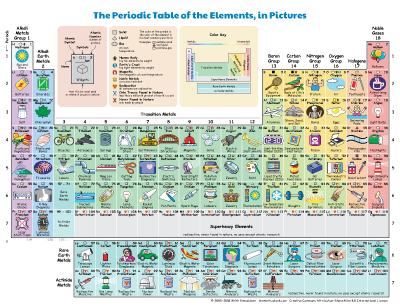
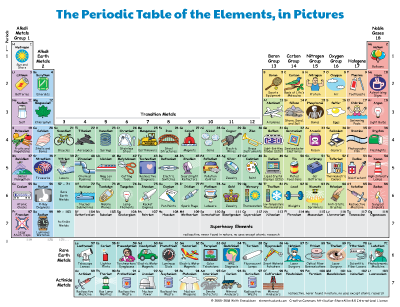
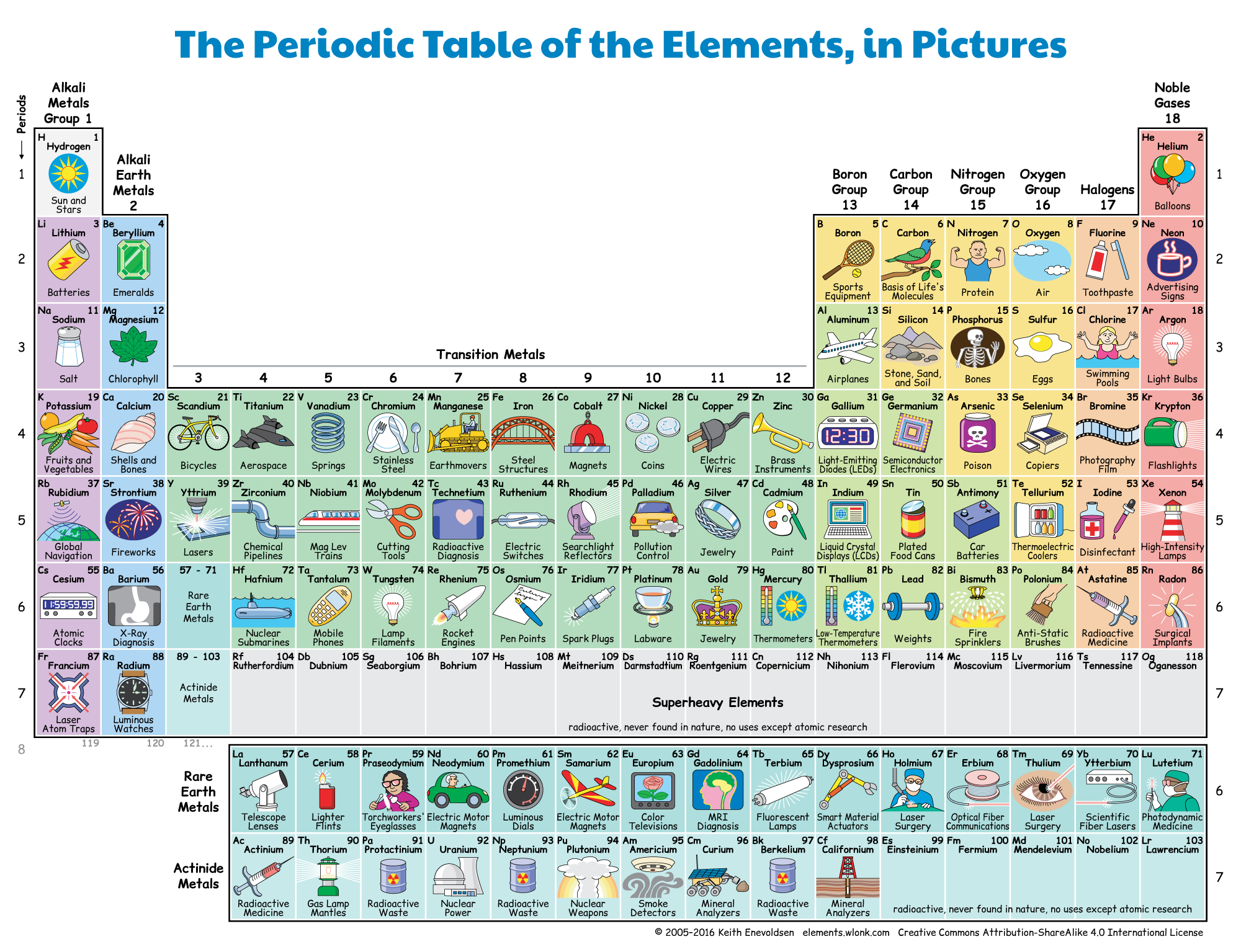
This pictorial periodic table is colorful, fun, and packed with information. In addition to the element's name, symbol, and atomic number, each element box has a drawing of one of the element's main human uses or natural occurrences. The table is color-coded to show the chemical groupings. Small symbols pack in additional information: solid/liquid/gas, color of element, common in the human body, common in the earth's crust, magnetic metals, noble metals, radioactive, and rare or never found in nature. It does not overload kids with a lot of detailed numbers, like atomic weights and valence numbers.
Note: Elements in Pictures and Elements in Words are a set. Either may stand alone, but they work best together.
See also: Interactive Periodic
Table of the Elements, in Pictures and Words.
This contains most of the same information on an interactive web page.
See also: Links to translations in other languages.
The Periodic Table of the Elements, in Words
Hi-res PDF for viewing/printing (2 pages, Pictures and Words)
Print at letter size (11x8.5 in) or poster size.
Medium-resolution PNG image
Buy Poster
CC BY-SA
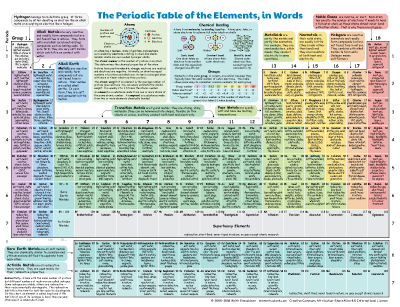
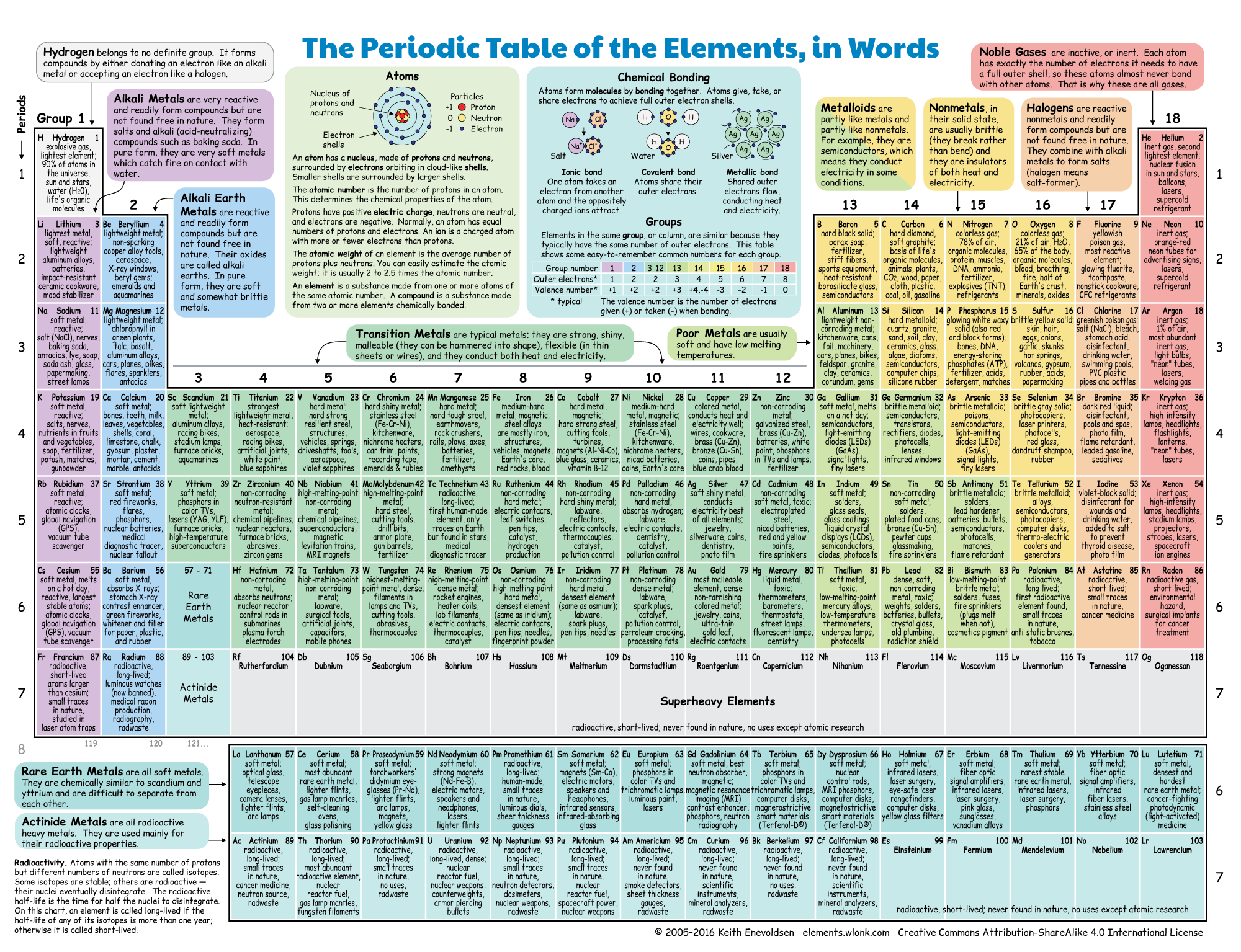
This textual periodic table is packed with even more information. In addition to the element's name, symbol, and atomic number, each element box contains a textual description of the element's physical properties and a list of several of its human uses and/or natural occurrences. The table is color-coded to show the chemical groups, and each group is described in a panel of the same color. Other info panels describe atomic structure, chemical bonding, and radioactivity. It does not overload kids with a lot of detailed numbers, but it does provide some simple rules-of-thumb about atomic weights and valence numbers.
See also: The Elements
— Descriptions, Uses and Occurrences.
This contains most of the same information, but in a less graphical,
more textual html format. It also contains handy links to search for
more info about each use.
The Periodic Table of the Elements, in Pictures and Words
Print at ledger size (11x17 in) or poster size.
Buy Poster
CC BY-SA
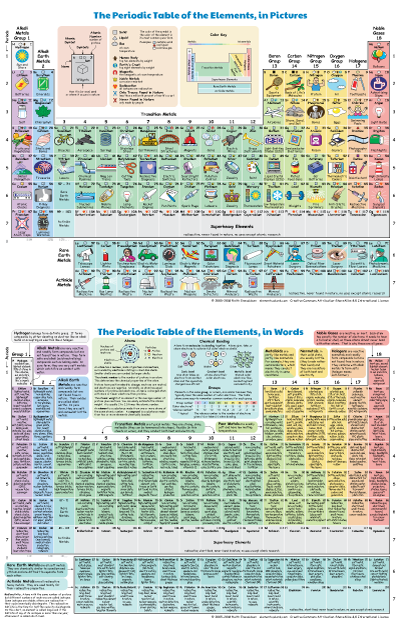
This has both Elements in Pictures and Elements in Words combined on a single page.
See also: Interactive Periodic
Table of the Elements, in Pictures and Words.
This contains most of the same information on an interactive web page.
The Periodic Table of the Elements, in Pictures (Simplified)
Print at letter size (11x8.5 in) or poster size.
Medium-resolution PNG image
Buy Poster, T-shirt, etc.
CC BY-SA
This is exactly the same as Elements in Pictures above, but with less information. The fine print — the legend boxes and the small symbols — have been removed. Use this if you want a cleaner image with less visual clutter, or you want less information, or you want to print smaller or at lower resolution.

Elements Cards

Hi-res PDF for printing cards (32 pages, 16 sheets)
Print at letter size (8.5x11 in) double-sided on card stock.
CC BY-SA
Print-your-own elements cards. Use these however you want. It's fun to simply lay them out to make the whole periodic table. You can use them as flash cards to help you memorize the facts on the front and back of each card. If you want to play it as a game, you can invent your own game rules.
Print double-sided on card stock. Cut out cards with paper cutter or scissors. Nine cards per sheet. There's a card for every element, with a picture on the front and words on the back. Also included are key cards (symbol key and color key), info cards (atom info and bonding info), and group info cards. The zip file also includes a template for making a card box. It also includes printing instructions.
Sorry, card decks are not for sale at the Wlonk Shop. You need to print them yourself. See Links for cards at other shops.
Elements Sheets

Hi-res PDFs for Printing Sheets (one sheet per element)
Print at letter size (8.5x11 in) single-sided.
CC BY-SA
Print each element on a separate sheet. You can make a very large periodic table to cover a large wall. Or you can use the sheets separately, for example, each student chooses one element.
Print single-sided. Elements 1-98 have pictures. Also included are key sheets (symbol key and color key), info sheets (atom info and bonding info), and group info sheets.
Sorry, elements sheets are not for sale at the Wlonk Shop. You need to print them yourself.
Student Worksheets
Print at letter size (8.5x11 in) single-sided.
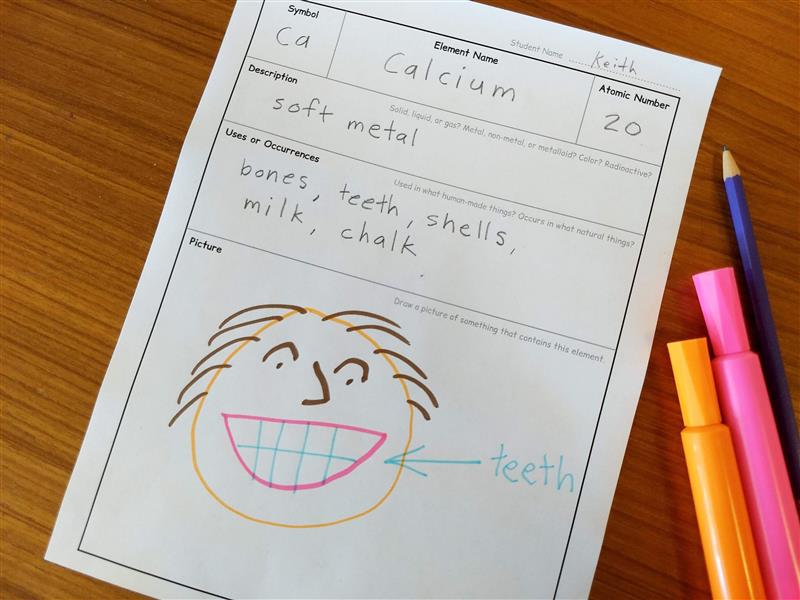
Printable student worksheet. Print one or many per student. This worksheet has spaces for the student to write the element's symbol, name, atomic number, description, uses and/or occurrences, and a space to draw a picture.
Are you homeschooling? This activity can occupy your student for one or many days. If you want a big activity, print out 98 of these worksheets, and assign your student to research every element from 1 to 98 (the elements with uses) and fill out a worksheet for each element, one or a few elements per day. This not just busywork; knowing some facts about each element is useful basic knowledge for many careers: engineering, manufacturing, biology, medicine, ecology, agriculture, geology, physics, and, of course, chemistry!
Alternative Periodic Tables

Students will have fun builiding paper models of all these alternative periodic tables. Then they can discuss how the models are different and yet the same.
Left-step Periodic Table
This left-step periodic table is the basis for the spiral, cone, and cylinder models.


This left-step table is a slightly modified version of the left-step table by Charles Janet (1928). This compact version places hydrogen, helium, lithium, and beryllium all in a single row.
Note that hydrogen is unique — it may be grouped with the alkali metals (like lithium) because it has one electron available to donate, grouped with the halogens (like fluorine) because gaining one electron will fill its valence shell, or it may be put in a group of its own.
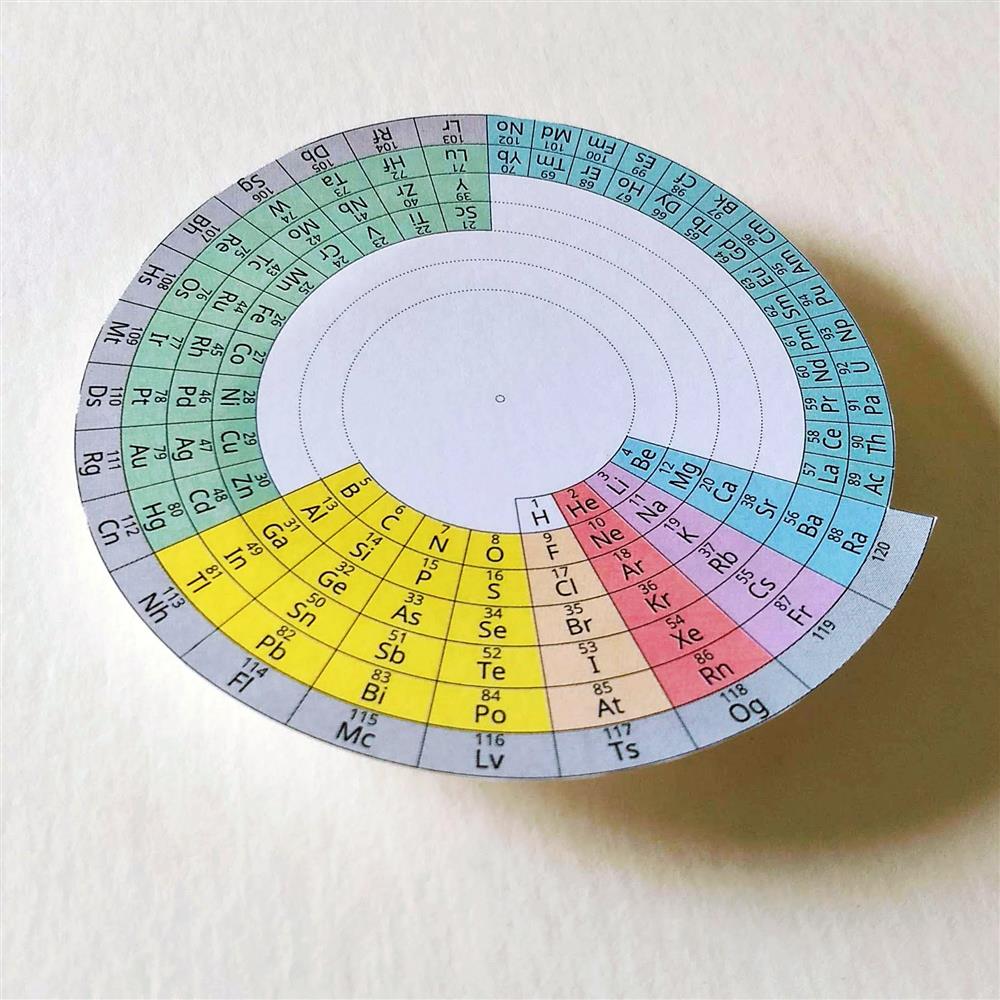
Spiral Periodic Table
In this periodic table, the elements are arranged in a single flat spiral (not concentric circles).

Conical Spiral Periodic Table
In this model, the elements are arranged in a single conical spiral (not stacked rings).


The paper model above is very easy to make. The more elaborate paper-and-plastic model below is more difficult to make.


Cylindrical Helix Periodic Table
In this model, the elements are arranged in a single cylindrical helix (not stacked rings).


The paper model above is very easy to make. The more elaborate paper-and-plastic model below is more difficult to make.


Atomic Orbitals
Atomic Orbitals (Color)

Print at letter size (11x8.5 in) or poster size.
Buy Poster
CC BY-SA
This color-coded chart shows what atoms look like. This chart shows all the fundamental atomic electron orbitals as electron probability density distributions (fuzzy clouds), which is close as you can get to visualizing what an atom really looks like. The orbitals are labeled. It describes other ways to visualize atoms, namely, electron orbits (like planets) and surfaces of constant probability (bulgy blobs). It has a small periodic table showing in which order the electron shells are filled.
Atomic Orbitals (Black)

Print at letter size (11x8.5 in) or poster size.
Buy Poster
CC BY-SA
This white-on-black chart shows what atoms look like. This chart shows all the fundamental atomic electron orbitals as electron probability density distributions (fuzzy clouds), which is as close as you can get to visualizing what an atom really looks like. The orbitals are labeled. This elegant chart has little visual clutter.
See other web sites for 3D visualizations. See Links for 3D products.
See also: Plain atomic orbitals chart (color) and Plain atomic orbitals chart (black)
Particles
Particles (Standard Model)

Print at letter size (8.5x11 in) or poster size.
Buy Poster
CC BY-SA
This chart shows what the universe is made of. This chart shows all the elementary particles in the standard model (SM) of particle physics, and many non-elementary particles too. It starts with the basics: an atom contains a nucleus of protons and neutrons, which are made of quarks. The chart organizes all the important particles and classes of particles: elementary fermions (quarks, leptons, electrons, neutrinos), elementary bosons (gluons, photons, W and Z bosons, Higgs, and gravitons [predicted]), composite particles (hadrons, baryons, protons, neutrons, mesons), anti-particles.
See also: Plain list of particles.
Reference: IUPAC is the world authority on the naming of elements (see IUPAC periodic table).